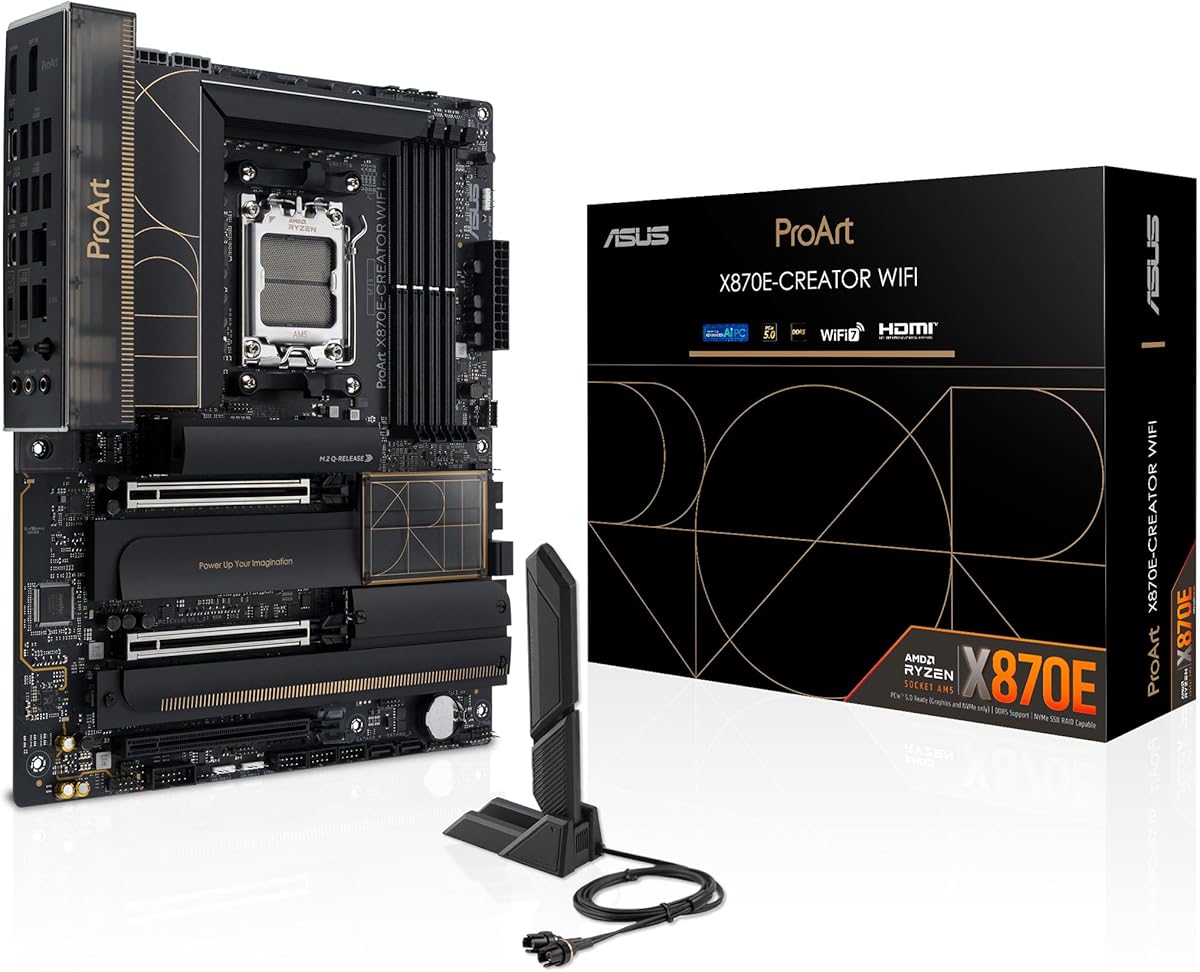
ASUS ProArt X870E-CREATOR WiFi
4.3Editor score
Full Support for Next-Gen GPUs
Dual USB4 High-Speed Connectivity
Robust 16+2+2 Power Stages
This expert guide compares the top motherboards for neural network workloads, evaluating power delivery, connectivity, and AI-ready features for 2026 builds.
Selecting the right motherboard for neural network tasks requires careful attention to power delivery, memory bandwidth, and expansion capabilities for high-performance GPUs.
We evaluated ten leading models based on VRM stability, PCIe lane configuration, AI-specific features, and connectivity options essential for modern machine learning workflows.
Each pick highlights unique strengths for AI training and inference workloads, though pricing and availability may vary over time as you review these detailed comparisons.
4.3Editor score

4.4Editor score

4.4Editor score
The following comparison table provides a side-by-side overview of specifications and key features across all ten selected motherboards for neural network applications.


This flagship motherboard stands out for neural network builds requiring stable power and high-speed connectivity for next-generation GPUs and accelerators.
We may earn a commission when you buy through this link, at no additional cost to you.
Its 16+2+1+2 power stages ensure consistent performance under heavy training loads, while Thunderbolt 5 offers unprecedented data transfer speeds for large datasets.
Although the cost is high, the integration of AI-specific tools like AI Overclocking and NPU boost justifies the investment for professional machine learning practitioners.
If you prioritize cutting-edge performance and reliability for complex workloads, this model delivers the foundation needed for serious AI experimentation and deployment.
The combination of robust VRM design and Thunderbolt 5 ensures your system remains stable and fast during intensive neural network training cycles.
Exclusive software tools help users fine-tune overclocking and cooling parameters to maximize hardware efficiency for AI tasks without manual intervention.
We may earn a commission when you buy through this link, at no additional cost to you.
Designed for advanced AI PCs, this motherboard combines AM5 socket support with future-proof features like USB4 and PCIe 5.0 x16 slots for maximum GPU performance.
We may earn a commission when you buy through this link, at no additional cost to you.
The 16+2+2 power stages provide robust voltage regulation essential for Ryzen 9000 series processors when running sustained neural network workloads without throttling.
While expensive, the inclusion of four M.2 slots and dual 10Gb Ethernet ensures ample storage and network bandwidth for massive dataset handling during training.
Professional users needing top-tier AMD performance will find this board offers the stability and connectivity required for serious machine learning development.
Dual USB4 ports enable rapid external storage access and high-speed peripheral connections critical for managing large neural network datasets efficiently.
With sixteen power stages, the VRM delivers clean and consistent power to the CPU even during long training sessions requiring maximum clock speeds.
We may earn a commission when you buy through this link, at no additional cost to you.
This model delivers exceptional value for those starting neural network projects, offering AM5 support and DDR5 memory at a fraction of the cost of flagship boards.
We may earn a commission when you buy through this link, at no additional cost to you.
Despite the lower price, it features a 14+2+1 power phase design capable of handling mid-range Ryzen processors effectively for inference and light training tasks.
The inclusion of a PCIe 5.0 M.2 slot provides future-proof storage speed, while WIFI6E ensures reliable connectivity without needing expensive add-in network cards.
Budget-conscious students or hobbyists will appreciate this board as a solid foundation to build capable AI workstations without overspending on unused features.
The B650 chipset offers a sweet spot of features for AI entry-level users without requiring the premium price of high-end X-series alternatives.
Integrated WIFI6E and 2.5Gb Ethernet provide dependable network speeds for downloading models and datasets without additional hardware costs.
We may earn a commission when you buy through this link, at no additional cost to you.
While using the older AM4 socket, this board remains a strong contender for those transitioning into AI projects without immediately upgrading to the newest CPU generation.
We may earn a commission when you buy through this link, at no additional cost to you.
The 12+2 power stages and PCIe 4.0 support ensure stable performance for mid-range training tasks, making it a viable option for inference or smaller model development.
Its high rating reflects long-term reliability, though users should note the lack of support for Ryzen 9000 series chips and DDR5 memory bandwidth.
Ideal for budget builds or legacy upgrades, it offers a proven foundation with modern connectivity like WiFi 6E to keep current systems competitive.
AM4 systems with this board offer stable performance for entry-level neural networks without requiring an immediate full system overhaul.
Integration of WiFi 6E and 2.5Gb LAN ensures fast data transfer speeds even on an older platform generation.
We may earn a commission when you buy through this link, at no additional cost to you.
Positioned as an AI Ready model, this motherboard bridges the gap between budget and premium with robust power stages and next-gen connectivity for modern workloads.
We may earn a commission when you buy through this link, at no additional cost to you.
The 80A power stages provide ample headroom for Ryzen 7000 and 9000 processors, ensuring thermal stability during extended inference or training sessions.
With Wi-Fi 7 and USB 20Gbps Type-C support, data transfers and remote access are significantly faster than previous generation wireless and wired standards.
Mid-range users seeking the latest features without the flagship price tag will find this board offers excellent value for building capable AI systems.
AI Ready optimizations help streamline system setup and performance tuning for machine learning workflows right out of the box.
Wi-Fi 7 and USB 20Gbps Type-C ensure your system stays connected and data moves quickly during critical training phases.
We may earn a commission when you buy through this link, at no additional cost to you.
This X870 model offers near-flagship performance with features like USB4 and four M.2 slots that cater to users needing fast storage and peripheral connectivity for data pipelines.
We may earn a commission when you buy through this link, at no additional cost to you.
The 16+2+1 power stages handle heavy CPU loads with ease, ensuring that Ryzen 9000 series processors run at peak performance during intensive computations.
With Wi-Fi 7 and dynamic overclocking tools, the board provides a comprehensive suite of features to maximize system responsiveness for complex workflows.
Users wanting high-end specs without stepping into the ProArt premium tier will appreciate this board's blend of durability, speed, and practical design.
Four M.2 slots allow for massive fast storage capacity, essential for local caching of large datasets during neural network training.
USB4 40Gbps provides a direct path to fast external storage and high-bandwidth peripherals without bottlenecking system performance.
We may earn a commission when you buy through this link, at no additional cost to you.
Targeting performance enthusiasts, this board emphasizes memory speed with support for up to 8200+ MT/s DDR5 RAM, which is crucial for reducing model training times.
We may earn a commission when you buy through this link, at no additional cost to you.
The PCIe 5.0 x16 slot ensures your graphics card has the full bandwidth available, while M.2 Gen5 support offers ultra-fast storage options for active datasets.
While thermal pads are needed to prevent throttling on Gen5 drives, the robust power design handles high-end Ryzen processors reliably during long sessions.
Gamers and AI hobbyists who value raw speed and overclocking potential will find this board provides the hardware foundation for a high-performance system.
Support for high-speed DDR5 reduces latency and improves data throughput significantly for large-scale model training tasks.
M.2 Gen5 support enables blazing-fast read and write speeds necessary for handling massive model checkpoints quickly.
We may earn a commission when you buy through this link, at no additional cost to you.
Standing out with its white PCB design, this board delivers AI PC features and PCIe 5.0 support to users prioritizing both style and technical capability in their workspace.
We may earn a commission when you buy through this link, at no additional cost to you.
The 8+2+1 power phase is sufficient for standard Ryzen 5 and 7 processors, providing stable operation for most neural network inference and light training use cases.
With BIOS Flashback and comprehensive cooling headers, the board simplifies hardware management and thermal control for consistent system reliability.
Builders wanting a visually unique yet functional system for AI workloads will appreciate the balance of design and performance offered by this specialized variant.
Built-in AI PC readiness includes optimizations that streamline system tasks for modern machine learning workflows without extra software overhead.
The white PCB allows for striking builds that stand out in professional studios where visual appeal matters alongside functionality.
We may earn a commission when you buy through this link, at no additional cost to you.
Part of the PRO series, this motherboard focuses on essential features for professional use with a robust power system that supports high-end Ryzen processors effectively.
We may earn a commission when you buy through this link, at no additional cost to you.
With DDR5 Memory Boost and M.2 Gen5 support, it provides significant speed advantages for data pipelines without the cost of premium gaming-oriented motherboards.
The inclusion of 5G LAN and Wi-Fi 7 ensures fast network connectivity which is vital for distributed training environments or large dataset transfers.
Professionals prioritizing functionality and speed over flashier features will find this board a reliable workhorse for stable neural network development.
The 12 Duet Rail Power System ensures consistent voltage stability for CPU operation under load without overheating or throttling.
Wi-Fi 7 and 5G LAN provide high-throughput networking needed for collaborative AI projects and cloud resource access.
We may earn a commission when you buy through this link, at no additional cost to you.
For enterprise-grade neural network training, this motherboard supports Threadripper PRO CPUs and ECC memory to ensure reliability and massive processing power for complex models.
We may earn a commission when you buy through this link, at no additional cost to you.
The 36 power stage design delivers unmatched stability for high-core count CPUs, allowing sustained performance during weeks-long training cycles without failure.
Support for up to 1TB of ECC R-DIMM ensures large datasets can be loaded into system RAM for faster processing than typical consumer boards allow.
Large-scale researchers needing multi-GPU support and enterprise-grade features should consider this workstation motherboard as the ultimate platform for demanding workloads.
ECC memory and robust power stages ensure data integrity and continuous operation during critical long-term training projects.
Multiple PCIe 5.0 x16 slots enable simultaneous training across multiple GPUs, dramatically reducing time to result for deep learning models.
We may earn a commission when you buy through this link, at no additional cost to you.
Choosing the right motherboard for neural network workloads involves evaluating power delivery, expansion slots, and connectivity to ensure your system can handle intensive tasks.
Neural network training pushes CPUs to maximum limits, so a board with strong VRM power stages (14+) is essential to prevent throttling.
Look for motherboards with sufficient phases and high-quality components to ensure stable voltage delivery during extended compute sessions.
Ensure the motherboard supports PCIe 5.0 x16 slots to take full advantage of modern GPUs used for deep learning tasks.
Verify that multiple GPUs can run at full bandwidth if you plan to scale up your training environment.
DDR5 support is now standard for AI builds as it provides the necessary bandwidth for fast data movement between CPU and RAM.
Consider boards that support high-capacity DDR5 and allow for high-speed overclocking if you plan to load large datasets into system memory.
Fast storage is critical for loading datasets quickly during training; look for motherboards with multiple M.2 slots including Gen5 support.
Prioritize boards with robust heatsinks on M.2 slots to prevent storage throttling during high-speed read operations.
High-speed networking such as 10Gb Ethernet or Wi-Fi 7 helps move large datasets quickly if you are working in a distributed environment.
Check for USB4 or Thunderbolt ports if you need to connect high-speed external storage or accelerators directly to the system.
Many modern motherboards include AI-specific tools that automate overclocking and cooling adjustments to optimize performance for compute tasks.
Look for features like AI Advisor or NPU boost to simplify tuning and maintain efficient system operation during workloads.
Ensure the socket matches your chosen CPU generation, such as AM5 for Ryzen 9000 or LGA1851 for Intel Core Ultra.
Future-proofing is essential; choose a socket that supports upcoming processor generations to extend the lifespan of your build.
Thermal management is key for continuous training; select motherboards with VRM heatsinks and fan headers to maintain stable temperatures.
Boards with dedicated chipsets and M.2 cooling solutions prevent heat soak that could otherwise limit performance during long runs.
Install your motherboard in a well-ventilated case and ensure the CPU cooler is properly mounted to avoid heat buildup during training tasks.
Regularly update your BIOS to the latest version to maintain compatibility with new CPUs and improve overall system stability for AI workloads.
Monitor your system temperatures using software tools to ensure that power delivery components do not overheat under sustained load conditions.
While any modern motherboard can handle basic inference, dedicated AI builds benefit from boards with robust VRMs, PCIe 5.0 support, and high-speed storage to prevent bottlenecks. Look for features like ECC memory or specific AI optimizations if you run complex training jobs.
More power phases mean more stable voltage delivery to the CPU. Neural network workloads can push CPUs to high loads for long periods, and insufficient power stages can lead to thermal throttling or system instability.
Yes, high-end consumer boards are often sufficient for most developers and researchers. Professional-grade boards are typically reserved for multi-GPU enterprise setups requiring ECC memory and extensive PCIe lanes.
Both offer excellent options for AI. AMD AM5 provides strong multi-core performance and PCIe 5.0, while Intel supports specific NPU features. The best choice depends on your specific CPU preference and budget.
Wi-Fi 7 offers faster data rates which help with downloading large datasets. However, wired Gigabit Ethernet is usually sufficient for most home setups unless you require high-speed wireless data transfer.
At least two fast M.2 slots are recommended for training and storage separation. If you manage massive datasets, four M.2 slots with Gen5 support provide ample room for expansion.
ECC memory is generally not necessary for hobbyists or typical enterprise developers. It is primarily useful for mission-critical enterprise workloads where data integrity over long training times is paramount.
AI features often provide automated tuning that optimizes power delivery and cooling. While they may not drastically change peak performance, they help maintain stability and reduce manual configuration efforts.
We highlighted ten top motherboards ranging from budget entry-level boards to high-end workstations for neural network development in 2026.
When choosing your board, prioritize power delivery stability, PCIe bandwidth, and storage speed to ensure your system can handle the demands of modern AI tasks.
Always check current product details and pricing before purchasing since hardware availability and specs may shift as new models are released throughout the year.