
SUNLU Filament Dryer Box 2026 New Upgrade S1 Plus
4.3Editor score
Fast drying with fan
Visual LCD display
High capacity up to 210mm
This guide compares the top 10 filament dryer boxes for 2026, evaluating drying speed, capacity, temperature control, and storage features to help you choose
Filament dryer boxes are essential tools for 3D printing enthusiasts who need to maintain optimal material quality. Moisture absorption can ruin prints, causing stringing and weak layers. A good dryer box solves these issues by actively removing humidity from spools.
We compared ten leading models based on heating technology, capacity, user interface, and sealing effectiveness. Our analysis focuses on real-world performance, ease of use, and versatility across different filament types like PLA, PETG, and engineering materials.
Each pick highlights unique strengths for various printing needs. Note that product availability and pricing may fluctuate over time. Always verify current specifications before purchasing to ensure compatibility with your specific 3D printing workflow.
4.3Editor score

4.6Editor score

4.6Editor score
The following table provides a side-by-side comparison of all ten products. It highlights key specifications to help you quickly identify which dryer box fits your specific printing requirements and budget constraints.


The SUNLU Filament Dryer Box 2026 New Upgrade S1 Plus offers a cost-effective solution for keeping spools dry. With a 4.3 rating, it delivers reliable performance for everyday printing tasks without breaking the bank.
We may earn a commission when you buy through this link, at no additional cost to you.
Its standout feature is the integrated fan design which significantly speeds up the discharge of excess water. The visual display shows temperature, time, and humidity clearly. Users can adjust settings easily via the left and right buttons.
The temperature range is limited to 55°C maximum, which excludes high-temp engineering filaments. However, for common materials like PLA and PETG, this range is sufficient. The seal is good but not industrial grade.
This dryer is ideal for beginners or casual users who need basic protection against moisture. It fits standard 1kg spools easily. We recommend it for those prioritizing affordability over advanced engineering support.
The internal fan circulates air to remove moisture faster than passive heating units.
The LCD screen lets you monitor conditions without opening the box during printing.
We may earn a commission when you buy through this link, at no additional cost to you.
The Creality Space Pi X4 is a top-tier dryer designed for high-volume users. It holds four standard spools and features dual heating chambers. Its 4.6 rating reflects strong performance and user satisfaction.
We may earn a commission when you buy through this link, at no additional cost to you.
Dual independent 200W heating chambers allow for faster drying and even support different temperatures simultaneously. The touch UI is industry-first for this segment. Silicone sealing prevents moisture re-absorption effectively.
The price is high compared to basic boxes, but the capacity justifies it. It is large, requiring significant desk space. Power consumption is higher due to dual 200W heaters.
Buy this if you manage multiple printers or use engineering filaments needing high heat. It ensures print-ready filament in hours. It is the ultimate dryer for serious makers who need efficiency.
Two independent heaters remove moisture 30% faster than single-chamber dryers.
Customize temps for specific filament types with real-time display feedback.
We may earn a commission when you buy through this link, at no additional cost to you.
The Official Creality Filament Dryer Space Pi X4 DB-05 offers dual independent temperature control. It is built for efficiency and engineering-grade materials. Its 4.6 rating matches the performance expectations.
We may earn a commission when you buy through this link, at no additional cost to you.
It supports simultaneous drying of two filament types at different temperatures. The dual heaters provide consistent heat for difficult materials. Power-saving modes allow single-chamber operation for reduced costs.
You must use compatible plastic trays to ensure safety. The price is premium compared to standard dryers. It occupies significant workspace due to its four-spool capacity.
This dryer is best for professionals who need maximum capacity and temperature flexibility. It handles PC and PAHT reliably. Choose this if engineering precision and volume are your priorities.
Each chamber has its own heater for unique temperature settings.
Single-chamber mode saves up to 40% energy for lighter loads.
We may earn a commission when you buy through this link, at no additional cost to you.
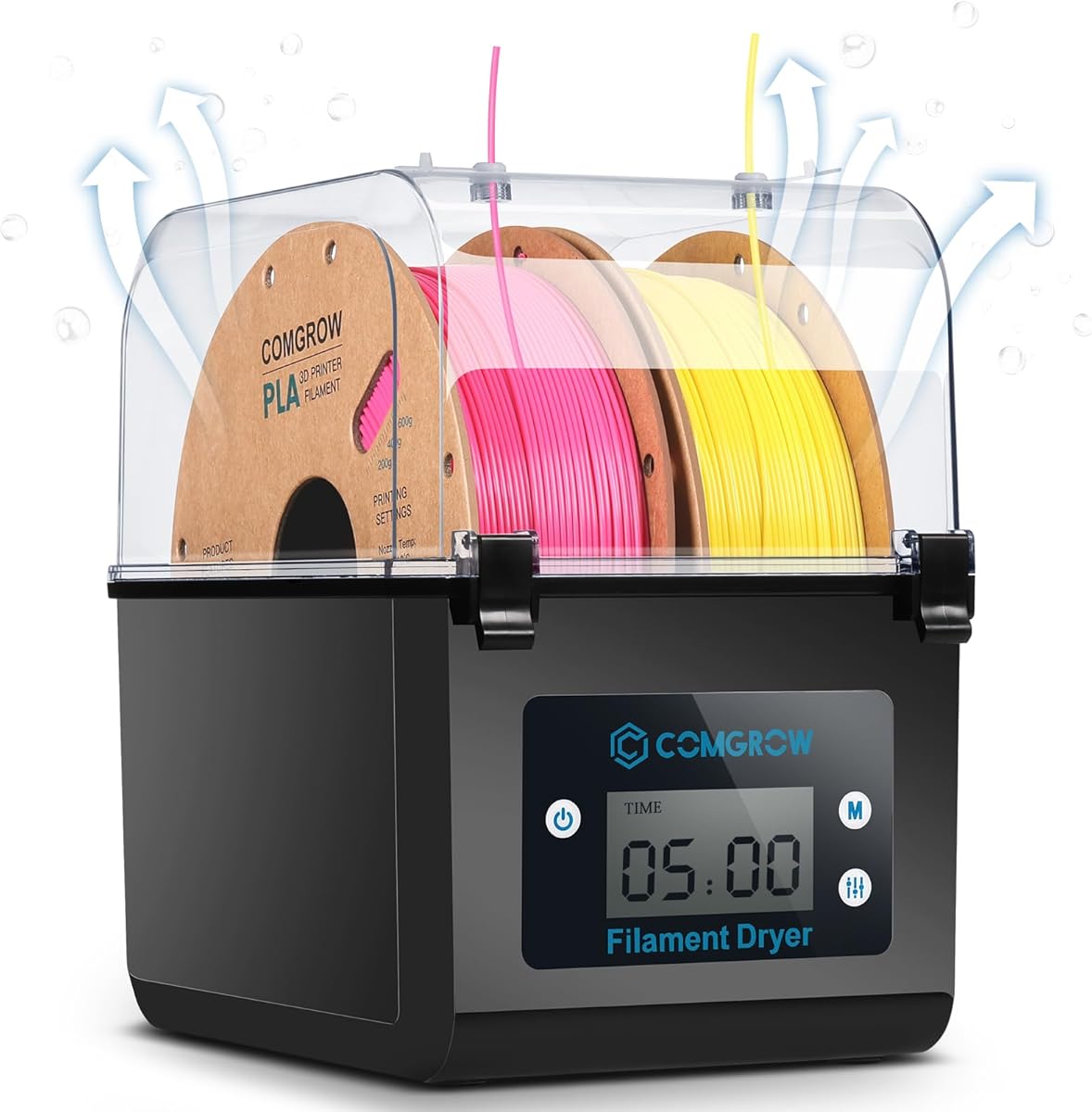
The Comgrow SH01 is a reliable dryer focused on keeping materials dry during printing. It holds two spools effectively and has a 4.4 rating. It is built for standard filament types like PLA and ABS.
We may earn a commission when you buy through this link, at no additional cost to you.
The internal heating provides a dry environment. A 2-inch LCD screen makes monitoring easy. The silicone cable sheath ensures smooth feeding. Sealing is robust when closed properly.
Temperature settings are limited to 50°C max which might not dry high temp plastics well. You must manually set the time. Auto shut-off protects the unit after idle time.
Buy this if you print PLA or PETG regularly. It is a solid middle ground between budget and advanced dryers. We recommend it for users who need consistent storage protection.
Keeps filament dry during printing to prevent moisture re-absorption.
Snap button structure ensures a tight seal to maintain humidity levels.
We may earn a commission when you buy through this link, at no additional cost to you.
The Polymaker Polydryer is a passive storage solution. It does not heat but offers a sealed environment. With a 4.4 rating, it is valued for its simplicity and hygrometer inclusion.
We may earn a commission when you buy through this link, at no additional cost to you.
The airtight enclosure reduces exposure to humid air. You can feed filament without breaking the seal. The hygrometer helps monitor conditions. It supports 1.75mm up to 3.00mm diameters.
Since it lacks heating, it cannot actively dry wet filament. You must rely on desiccants which require replacement. It is not suitable for long drying sessions of wet spools.
Choose this for storing filament between jobs or in dry climates. It protects against minor humidity spikes. It is best for users who prefer low-maintenance passive protection.
Reduces exposure to humid air to prevent common moisture issues.
Designed to support filament feeding while spools remain inside.
We may earn a commission when you buy through this link, at no additional cost to you.
The SUNLU Filament Dryer S2 is designed for larger spools and high capacity. It holds standard rolls up to 1kg. Its 4.3 rating indicates it is a straightforward tool for drying tasks.
We may earn a commission when you buy through this link, at no additional cost to you.
A built-in spindle ensures continuous rotation for even drying. The large touch screen makes setup easy. The translucent lid lets you check on the spool. Temperature range extends to 70°C.
The capacity is good for storage, but it takes up space. The interface is simple. It lacks advanced preset options. However, it is effective for reviving damp filaments.
This dryer is suitable for users who need to store and dry large batches. It helps optimize printing processes. We recommend it for those prioritizing spool compatibility.
Built-in spindle ensures filament spins continuously for even drying.
Translucent lid allows visual checks without opening the unit.
We may earn a commission when you buy through this link, at no additional cost to you.
The Comgrow SH02 features one-key temperature settings for different filaments. It uses a 150W PTC heater for speed. Its 4.4 rating shows it performs well for typical 3D printing needs.
We may earn a commission when you buy through this link, at no additional cost to you.
The touch screen is easy to use. Safety protections cut heating if limits are exceeded. Sealing rings prevent moisture leakage. It reaches 50°C in just seven minutes.
It has a maximum time of 98 hours. If the fan stops, an alarm sounds. This requires monitoring. The 2-spool capacity limits bulk storage.
Buy this if you want automated settings and fast heat-up. It handles common materials like ABS and ASA. We recommend it for users who value convenience.
Select filament type and drying starts immediately with correct parameters.
Temperature and fan sensors prevent overheating or module damage.
We may earn a commission when you buy through this link, at no additional cost to you.
The Creality Space PI 2026 model uses PTC 360° hot-air heating. It offers presets for 12 filament types. Its 4.4 rating reflects user satisfaction with its upgraded features.
We may earn a commission when you buy through this link, at no additional cost to you.
The touch screen supports switching between temperature scales. Power-off memory saves your settings. It allows you to customize temperature freely. The fan ensures uniform air circulation.
The 48-hour timer provides long drying cycles. However, PTC heating may require calibration for some filaments. The interface is intuitive but has many settings to learn.
This dryer is good for users needing versatility. It saves time with presets. We recommend it for those who print composite materials often.
Built-in fan circulates hot air 360° for uniform drying.
Remembers previous settings after power outage for fast restart.
We may earn a commission when you buy through this link, at no additional cost to you.
The Creality Space PI Plus supports dual spools for concurrent drying. It features a real-time humidity monitor. Its 4.4 rating shows it is well built for typical 3D printing needs.
We may earn a commission when you buy through this link, at no additional cost to you.
The humidity monitor helps track storage conditions. Adjustable temperature allows fine-tuning. It supports high-performance composites. The presets simplify workflow.
The humidity monitor needs occasional calibration. The spool count is limited. However, it offers better control than single-spool units.
Buy this if you need better monitoring and capacity. It is versatile for various materials. We recommend it for users who track humidity closely.
Monitor spools via real-time humidity data without breaking control.
Supports drying two spools simultaneously for efficiency.
We may earn a commission when you buy through this link, at no additional cost to you.
The Creality Space Pi X4L holds four spools and uses dual heating chambers. It reaches up to 75°C. Its 4.5 rating indicates it is a reliable tool for serious 3D printing needs.
We may earn a commission when you buy through this link, at no additional cost to you.
The illuminated window lets you monitor spools. Dual chambers provide better efficiency. It supports engineering filaments. The drying process is rapid.
Power consumption is high. The unit takes significant space. However, the speed and capacity make up for it.
This dryer is ideal for users with large inventories. It reduces drying time significantly. We recommend it for workshops with high throughput.
Dual independent chambers remove moisture 30% faster than single ones.
Monitor spools via illuminated window without breaking humidity control.
We may earn a commission when you buy through this link, at no additional cost to you.
Selecting the right filament dryer box depends on your specific materials, printing volume, and budget. This guide helps you prioritize the features that matter most.
Capacity determines how many spools you can dry at once. Basic models hold one or two standard 1kg spools. High-volume options like the Space Pi X4 hold four. Consider your current inventory and storage space before choosing. A model that holds two spools allows for simultaneous drying of different materials.
Choose a capacity that matches your workload. Too small causes bottlenecks; too large wastes desk space.
Different materials require different drying temperatures. PLA needs low heat while PETG and Nylon need higher. Engineering filaments require up to 85°C. Check the maximum temperature to ensure it covers your needs. Avoid units limited to 50°C if you use tough materials.
Verify the max temperature matches your filament requirements. This ensures effective drying and better print quality.
PTC heaters provide uniform and safe heating. Some units use passive heat or pads that may heat unevenly. Fan-assisted units circulate air faster for quicker results. Look for 360° air circulation to prevent hot spots. This technology extends filament life by reducing uneven exposure.
Prioritize units with active circulation. Consistent heat ensures the entire spool dries evenly.
The interface should be intuitive to use. Touch screens make adjustments quick. Physical buttons are durable but can be slower to set. Look for preset modes for common materials. This reduces setup errors and saves time during busy sessions.
Choose an interface that suits your workflow. Presets help avoid complex manual calculations.
Safety mechanisms prevent overheating and fires. Units with thermal cutoffs shut off if limits are exceeded. Fan sensors warn you if the cooling system fails. Overheating can damage filaments or the box itself. Safety features add peace of mind.
Ensure the unit has thermal protection. This prevents hazards when running long drying cycles.
Sealing prevents moisture from re-entering the box. Silicone rings and tight lids are essential. Some boxes allow printing while sealed so humidity stays low. Check for sealed outlets for the filament. This feature doubles as a storage container.
Good sealing preserves filament dryness. Look for airtight designs to maintain protection.
Reading reviews helps identify common issues. High ratings suggest reliability and durability. Users often report on build quality or ease of use. Avoid models with consistent complaints. Feedback highlights real-world performance beyond specs.
Check reviews for long-term reliability. Consistent praise suggests a solid investment.
Basic models cost less but offer fewer features. Premium models have dual chambers and higher capacities. Balance cost against your printing needs. High capacity is only worth it if you print often. A budget unit works fine for hobbyists.
Invest more if you print frequently. Otherwise, a basic unit suffices for occasional use.
Place spools inside carefully ensuring the filament feeds smoothly through the outlet. Avoid twisting the filament to prevent jams. If using the unit while printing ensure the exit tube is connected to the printer extruder correctly. This setup allows continuous drying during the print job.
Set the temperature based on your filament type. Refer to manufacturer guidelines for optimal heat. Avoid exceeding the maximum temperature to prevent melting. Use the preset buttons if available to save time. Regular monitoring ensures safe operation.
Clean the unit periodically to remove dust. Check the fan and vents for blockages. Ensure sealing rings are intact for best performance. Replace them if they look worn. Proper care extends the lifespan of the dryer.
Drying time depends on how wet the filament is. Most units require 4 to 12 hours for effective drying. Some models offer preset times for common materials. Check the spool before drying to estimate duration.
Yes many boxes offer dual functionality. You can store dry filament and maintain humidity. Sealed designs prevent moisture from returning. This saves space by combining drying and storage.
PLA requires low heat typically between 40 and 50 degrees Celsius. Higher temperatures can warp or melt PLA spools. Always start with the lowest effective setting to preserve material integrity.
Keep the box sealed when not in use. Do not leave the door open after drying. Use desiccant packs for extra protection during storage. A tight seal is crucial for long-term dryness.
Most models have safety features like auto shut-off. However continuous monitoring is recommended for extended use. Check the manual for specific overnight guidelines. Safety sensors reduce risk significantly.
Dual chamber models allow different temperatures simultaneously. Single chamber units dry one type at a time. Ensure compatible materials are used together to avoid cross-contamination.
We reviewed ten top dryer boxes ranging from budget to premium. The SUNLU S1 Plus offers great value while the Creality Space Pi X4 provides high capacity. Your choice depends on print volume and material needs.
Prioritize temperature range and capacity based on your projects. Safety features and sealing quality are crucial for long-term performance. Consider if you need passive storage or active drying capabilities.
Remember to check current availability and verify specs before buying. Prices may vary based on stock and promotions. Choose a unit that fits your workflow today to ensure smooth printing tomorrow.