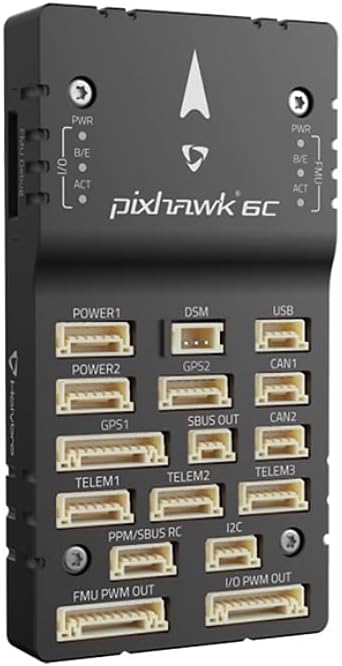
Pixhawk 6C Flight Controller, High-Performance STM32H743 480MHz Processor
Dual redundant IMU
480MHz processor
Integrated vibration isolation
This guide compares the top 10 flight controllers for hybrid VTOL and VTOL drones, evaluating performance, firmware support, and compatibility for every pilot.
Selecting the right flight controller is critical for hybrid VTOL and VTOL drones to ensure stable transitions between vertical lift and forward flight.
We evaluated ten leading models based on processor speed, sensor redundancy, firmware flexibility, and ease of integration with various drone frames.
Each pick highlights key strengths and trade-offs to help you find the best match for your build while keeping in mind that prices fluctuate regularly.

4.8Editor score

5.0Editor score
The following table provides a side-by-side comparison of the ten selected flight controllers highlighting their key specifications and compatibility features.



The KK 2.1.5 is a classic budget controller that offers essential self-balancing and VTOL capabilities for hobbyists and small projects.
We may earn a commission when you buy through this link, at no additional cost to you.
Its simplicity makes it easy to understand flight dynamics without needing complex software setup which is great for learning the basics.
However it lacks the processing power and sensor redundancy needed for high performance autonomous missions or heavy commercial payloads.
This is best for pilots who need a reliable starter board for light models without worrying about expensive components or complex tuning.
This board provides a cost effective way to experiment with VTOL configurations without investing in expensive autopilot systems.
The straightforward setup process allows users to get flying quickly without needing to navigate complex ground station software.
We may earn a commission when you buy through this link, at no additional cost to you.
The COREWING F405 V2 delivers the processing speed of an STM32F405 which is standard for modern high performance flight controllers in the hobby.
We may earn a commission when you buy through this link, at no additional cost to you.
It is marketed as fitting both airplanes and drones which suggests a flexible firmware configuration suitable for fixed wing and multirotor builds.
While details are sparse the board likely supports popular firmware options that allow for customization of flight modes and sensor inputs.
Buyers should verify specific firmware compatibility before purchasing to ensure it meets the requirements for complex hybrid VTOL transition logic.
The F405 processor ensures smooth control loop performance essential for stable transitions between vertical and forward flight phases.
Its compatibility with different airframe types makes it a strong candidate for hybrid projects requiring both wing and rotor support.
We may earn a commission when you buy through this link, at no additional cost to you.
This PIX board uses an STM32F405VGT6 processor and includes a full suite of sensors such as the MPU6500 gyro and barometer.
We may earn a commission when you buy through this link, at no additional cost to you.
It explicitly supports MAVLINK SBUS PPM and CRSF protocols which covers most modern radio receivers and telemetry systems used today.
The board is designed for VTOL and multirotor builds making it a solid choice for custom projects requiring high voltage power systems.
Users should note that this is a controller only and does not include ESCs so additional component selection will be necessary.
The inclusion of dedicated gyroscope and barometer sensors ensures accurate altitude holding and stability during complex transition phases.
Support for multiple receiver protocols like CRSF and SBUS means you can use the latest telemetry radios without adapters.
We may earn a commission when you buy through this link, at no additional cost to you.
The Pixhawk 2.4.8 is a legendary platform in the open source drone community offering flexibility for researchers and custom builders alike.
We may earn a commission when you buy through this link, at no additional cost to you.
Its open source nature allows hobbyists and developers to modify code and add custom modules which is rare in commercial autopilots.
With a GPS included in the combo it provides a complete solution out of the box for basic waypoint missions and remote driving tasks.
While newer stacks exist this board remains a reliable choice for those who need extensive customization and a proven hardware ecosystem.
The open source design enables advanced users to tailor flight behaviors to specific mission requirements beyond standard presets.
Including a GPS module simplifies the build process by removing the need for separate sensor wiring and integration steps.
We may earn a commission when you buy through this link, at no additional cost to you.
This controller is specifically marketed for fixed wing drones with VTOL capabilities which simplifies the transition logic for hybrid airframes.
We may earn a commission when you buy through this link, at no additional cost to you.
It supports ArduPilot firmware and includes an app for configuration which lowers the barrier to entry for users without a PC setup.
The design prioritizes speed and stability ensuring smooth flight experiences that are critical for maintaining control during takeoff and landing.
Pilots looking for a dedicated fixed wing VTOL solution with simplified setup will find this board very convenient for field operations.
Built specifically for hybrid fixed wing designs this controller handles the complex switching between rotor and wing lift efficiently.
Using a smartphone app to tune parameters makes it easy to adjust settings without needing complex laptop software or cables.
We may earn a commission when you buy through this link, at no additional cost to you.
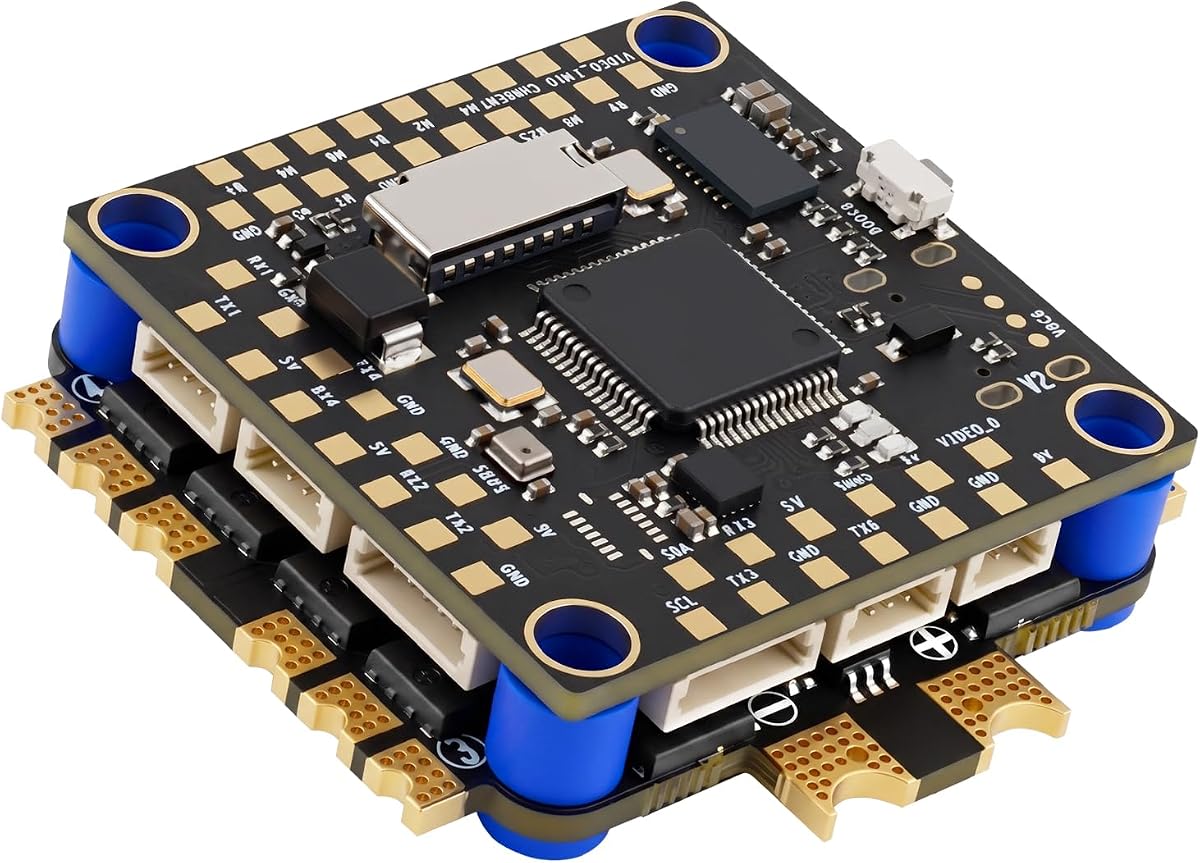
The H743 stack features an STM32H743 processor and supports up to 8S battery input making it ideal for high performance racing or heavy lift.
We may earn a commission when you buy through this link, at no additional cost to you.
It includes a 60A ESC which simplifies the build by integrating power distribution and motor control into one compact unit.
The board is compatible with multiple firmware options including INAV and ArduPilot which expands its utility beyond simple racing applications.
Although primarily sold for racing it can be configured for VTOL if the user is comfortable with advanced firmware configuration and setup.
Support for 8S batteries allows for high thrust to weight ratios essential for carrying heavy payloads or achieving fast speeds.
Dual IMUs provide extra redundancy which helps maintain stability even if one sensor suffers from vibration or interference.
We may earn a commission when you buy through this link, at no additional cost to you.
This variant pairs the H743 flight controller with a 50A ESC suitable for builds that do not require extreme power delivery for racing.
We may earn a commission when you buy through this link, at no additional cost to you.
It supports battery configurations up to 6S which is sufficient for most mid-sized drones that need stable performance without excessive weight.
The 30×30 mounting pattern ensures it fits in standard frames while the stack design reduces the need for extra wiring and connectors.
For hybrid projects needing reliable control without the cost of the higher end 8S options this board offers a practical middle ground.
The 30×30 form factor is the industry standard for many frames making it easy to swap in or upgrade existing builds.
Offering similar processor capabilities at a lower price point than higher end stacks makes it accessible for budget conscious builders.
We may earn a commission when you buy through this link, at no additional cost to you.
The Pixhawk 6C stands out with its STM32H743 processor and dual redundant IMUs which provide top tier reliability for autonomous missions.
We may earn a commission when you buy through this link, at no additional cost to you.
It features an integrated vibration isolation system that protects sensitive sensors ensuring accurate data even in high vibration environments.
Pre-installed PX4 Autopilot saves setup time and ensures compatibility with advanced mapping and planning software for complex workflows.
This board is best for professional or advanced users who demand maximum precision and reliability for critical tasks and research.
The integrated vibration isolation physically decouples sensors from the frame reducing noise and improving flight stability significantly.
Dual IMUs ensure that if one sensor fails or is noisy the system can switch to the other to maintain safety.
We may earn a commission when you buy through this link, at no additional cost to you.
This F405 stack is designed with O3 O4 support which makes it ideal for users building FPV drones with HD video transmission systems.
We may earn a commission when you buy through this link, at no additional cost to you.
It includes a DPS310 barometer and dual IMUs which are high quality components that improve altitude hold and flight smoothness.
The ESC is rated at 60A and the stack is compact making it easy to fit into smaller airframes without adding unnecessary bulk.
While it is a strong racing stack it can be adapted for basic VTOL tasks if the user prioritizes video transmission and speed.
Support for O3 and O4 interfaces ensures seamless compatibility with the latest HD video systems without extra wiring.
The DPS310 barometer provides precise pressure readings which helps maintain stable altitude in varying weather conditions.
We may earn a commission when you buy through this link, at no additional cost to you.
The AERO SELFIE H743 brings the power of the H7 processor to racing stacks which allows for smoother control loops and better responsiveness.
We may earn a commission when you buy through this link, at no additional cost to you.
It includes a 60A 32 bit ESC and CAN bus support which are premium features that reduce wiring complexity and improve motor communication.
The stack is compatible with PX4 and ArduPilot which adds versatility for users who want to experiment with different flight modes.
While reviews vary this board offers high end specifications that make it a strong candidate for advanced hobbyists and heavy lift builds.
A 32 bit ESC allows for more precise motor control and better efficiency compared to older 8-bit versions.
The ability to run different firmware makes this stack flexible for users who want to switch between racing and autonomous modes.
We may earn a commission when you buy through this link, at no additional cost to you.
Choosing the right controller requires balancing processing power, sensor redundancy, and firmware support for your specific build goals.
A strong processor like the STM32H743 or F405 ensures that the flight controller can run complex algorithms needed for smooth transitions between vertical lift and forward flight.
Look for at least an F405 or H7 class processor to avoid lag during high bandwidth sensor processing or advanced flight modes.
Dual IMUs and reliable barometers are critical for VTOL drones because they provide backup data if vibration affects one sensor during takeoff.
Prioritize boards that list dual IMU or redundant IMU features to ensure stable altitude and attitude data in noisy environments.
Ensure the controller supports firmware like ArduPilot or PX4 which offer robust VTOL transition logic and waypoint planning for hybrid airframes.
If you want advanced autonomy check that the hardware is officially supported by the firmware you plan to use for your missions.
Check the supported voltage range to ensure it matches your battery setup especially if you are using high voltage packs like 8S.
Some controllers only support up to 6S which limits your motor choices and overall power for heavy payloads.
Standard 30×30 stacks are easy to integrate into most frames but larger boards like Pixhawk 2.4.8 need more space and mounting hardware.
Measure your available space carefully before purchasing to avoid difficult modifications during the assembly process.
Modern receivers use protocols like CRSF or SBUS so make sure your controller has enough UART ports for all your sensors and receiver.
Having extra UARTs helps you add GPS and telemetry later without needing complex signal splitters or adapters.
For VTOL designs where motors are close to the board built in isolation or the ability to mount it on dampers is essential for accurate readings.
Vibration causes sensor noise which can lead to unstable flights or crashes during the critical hover to forward transition.
Open source platforms like Pixhawk have large communities that provide tutorials and troubleshooting which helps when configuring complex hybrid logic.
A strong community means you are more likely to find specific guides for your exact model or configuration.
Always install the flight controller on a soft mounting point like rubber grommets to protect it from vibrations that can cause false readings or flight instability.
Calibrate the IMU and compass on a flat surface away from magnets or interference to ensure the drone can maintain accurate orientation during transitions.
Keep the firmware up to date using the official ground station software to access the latest VTOL transition features and bug fixes for your system.
A VTOL controller must support firmware that manages two distinct flight modes and transitions smoothly between them. It should also have stable altitude hold and robust sensor filtering to handle the sudden changes in thrust and attitude.
Not necessarily but Pixhawk boards offer extensive support for open source autonomous software which is ideal for complex missions. For simpler hobby builds an F405 stack with the right firmware can also work.
You can use them if they support ArduPilot or INAV but they are optimized for racing. Check that the firmware includes specific VTOL mode logic and that the sensors handle high vibration from fixed wing props.
VTOL drones experience significant vibration during takeoff and landing which can confuse single sensors. Dual IMUs allow the system to cross check data and avoid crashes when one sensor loses accuracy.
Most boards use UART ports for GPS connections. Check the manual to find the correct UART and wire the GPS to it. Ensure the GPS is positioned away from motors to avoid signal interference.
Most boards come with software tools that simplify flashing. You can connect via USB or a dedicated cable and upload the latest version. Always back up your settings before updating to avoid losing custom configurations.
We reviewed ten top options from budget classic boards to modern H7 stacks ensuring you find the right power and reliability for your hybrid build.
Prioritize processing power and sensor redundancy if you plan to fly autonomous missions or carry heavy payloads that demand high stability during transitions.
Always check current prices and availability as models change frequently and you may find better deals or newer revisions online.